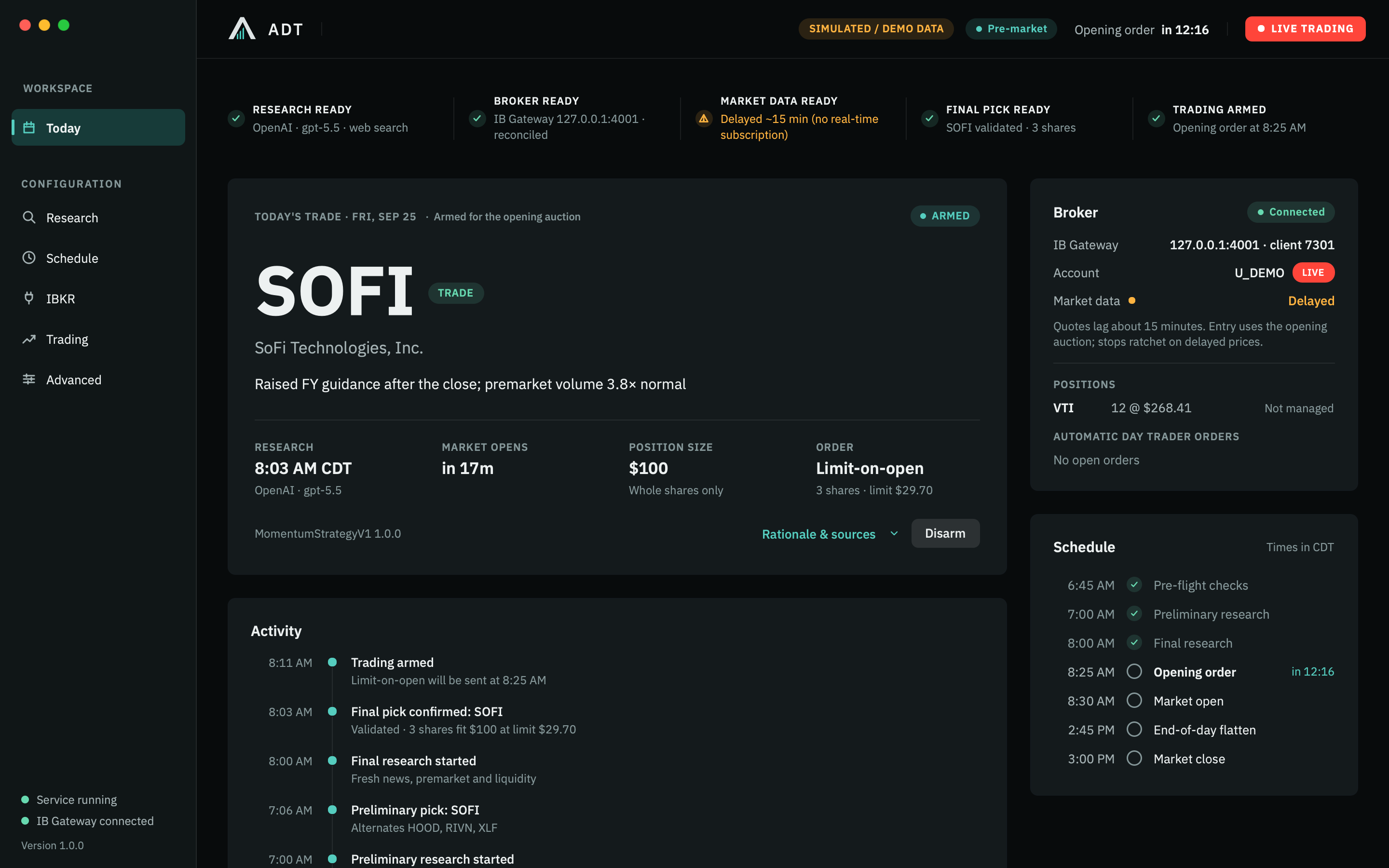
Two components with different responsibilities
AI-assisted research can assemble current information and propose a candidate under specified criteria. Deterministic execution applies defined rules to validated inputs and broker events. Separating them makes it possible to inspect the decision independently from the code that manages orders.
“Deterministic” describes a process with defined transitions for its inputs. It does not mean the market is predictable or that every run produces the same trade. Prices, research output and broker events change. The important boundary is that a model response does not silently replace the execution strategy.
In ADT, research receives a persisted session intent before ranking a candidate pool. Entry count, concurrency, position cap, whole-share sizing, aggregate capital, universe and eligibility constraints shape discovery from the start. The engine saves the pool and supporting evidence, then rechecks current price, spread, liquidity, buying power and existing exposure before each entry.
Current evidence matters more than fluent prose
A convincing explanation can contain stale information, unsupported statements or an ineligible instrument. The research pipeline needs current source material, explicit selection constraints and a way to reject unusable output.
ADT’s OpenAI and Anthropic adapters use native web search. An OpenAI-compatible or local endpoint requires a configured fresh-search source before its output can be treated as actionable. A local model’s stored knowledge alone is not a current market feed.
The application checks the structured decision and relevant eligibility constraints. These checks can reject malformed or incompatible output; they cannot prove that a thesis is correct or profitable. Operators should understand the source and timing of the research, not simply the model’s tone.
Save the decision before execution
Keeping a decision record makes a later session review possible. The question is not merely which candidate appeared on screen, but which accepted decision the engine used when it armed the session.
ADT separates preliminary research from the final decision. The saved final result becomes an input to execution checks. Eligibility, account authorization, sizing, calendar and existing exposure still matter. If conditions do not support one candidate, the system can advance deterministically to a qualified reserve. It never lowers research standards to satisfy a quota. A candidate, an entry attempt and a broker-confirmed position are separate records.
See the actual application walkthrough for how the research decision, order state and resulting position appear in the interface. All values there are fictional fixtures, not investment recommendations.
Model freedom should match the task
A system that lets an open-ended model choose an order, quantity, timing and recovery behavior has a different operating model from one that constrains the model to research. Do not evaluate these designs as interchangeable because both use an LLM.
Ask which actions are mechanical, which are model-generated, where validation occurs, what happens when research fails and whether the accepted input can be reconstructed later. Ask whether the system can place an order without the intended account authorization.
ADT does not provide an unrestricted prompt-to-trade agent. Its current workflow is eligible US stock or broad-ETF research followed by a defined long-only session process. Execution details and account controls explain that scope.
Provider keys, usage and expenses
Research is configured in Settings → Research. The application stores keys in the operating system’s credential store. Requests go to the configured research and search providers, which operate under their own terms. The public website does not receive those keys or the local trading database.
Provider charges are currently paid by the customer and are separate from ADT access. Usage depends on the model, search calls, output and retries. A fixed software subscription should not be interpreted as unlimited research tokens. Review pricing and setup before choosing the operating environment.
Never send a research API key through the website inquiry form. Use the application’s configuration flow and review which provider receives the information needed for the requested research.
Local models and free current news
A suitable local model can use Free news, the keyless GDELT discovery adapter, with optional SEC filing context when an organization/contact user agent is configured. Source links and observation times remain explicit; an observed time is not automatically a publication time. Missing fresh usable evidence returns No Trade. Public feeds have incomplete coverage and no availability guarantee.
This path avoids cloud-token and search-API charges. It does not remove computer costs, broker fees or market-data requirements. News headlines cannot replace current quotes, spreads and liquidity checks. Deterministic monitoring, protection and exits do not call the LLM.
Local hardware and the planned workstation
Running a model locally changes where inference occurs, but does not remove the need for current sources, machine availability or validation. Memory, model quality, execution time and search integration all need to be tested together. A compatible endpoint is not proof that an arbitrary model is suitable for this workflow.
The proposed ADT Workstation package is explicitly planned. Hardware, model selection and the complete local setup are not yet validated as a shipping package. It is available for detail requests, not immediate purchase. Do not treat its proposed perpetual software arrangement as a promise that every future external service will be free.
Evaluate the boundary in practice
During a paper rehearsal, record a valid research run, an invalid or unavailable run, and a session where entry conditions fail despite an available candidate. Confirm the execution behavior matches the saved decision and configured controls.
This tests the integration boundary. Strategy quality and live execution remain separate questions. Start with the paper-testing guide and inspect the architecture before considering live authorization.